How AI and Vibe Coding Initiatives Lead to Reliable and Valuable Custom Software for SMEs

A lack of functionality sparks the impulse
The business software in use has evolved over the years. Time and budgets for customizations are limited. With AI, proactive employees can quickly turn their own ideas into working applications. How can the company capitalize on this momentum?
Will be made available in the December update of Context World.

Goal: Preserving the Momentum
With AI, software can now be developed at an astonishing pace—even outside the realm of traditional IT. But what begins as the impetus for a valuable and ambitious initiative or prototype also stirs up emotions in day-to-day business operations and brings new challenges:
- Greater benefits arise across all areas, and based on the initial results of individual initiatives, additional requirements are emerging
- Documentation and training for users must be developed and provided
- The organizers actually have completely different responsibilities
- The IT department sets requirements for operations and security
It is precisely these challenges that serve as valuable sources of inspiration, allowing the initial idea to mature into a valuable solution within the company.
Impulse – Engagement – Transform
With Tolksdorf.digital’s structured approach, existing software gradually becomes understandable, verifiable, maintainable,
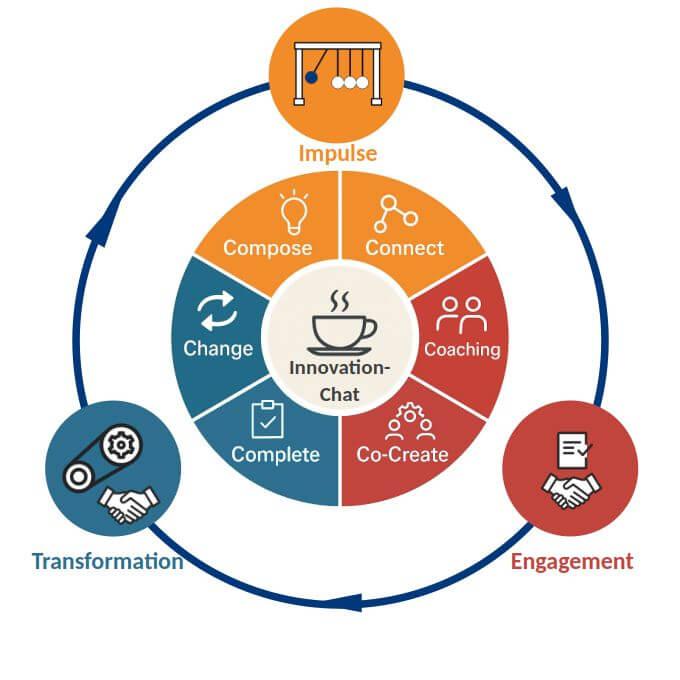
- Using our proven, action- and communication-oriented “Impulse – Engage – Transform” process model, we support initiatives from the very beginning, working closely with all stakeholders.
- Instead of focusing on shortcomings and assigning blame, the emphasis from the very beginning is on reaching mutually agreed-upon, desirable solutions. Whatever is liked gets done.
- This approach successfully embeds software initiatives within companies. We call it “7C-CI/CD”; it enables continuous innovation while maintaining delivery capability (Corporate Innovation / Continuous Delivery). After all, innovation requires a love of curiosity, the ability to draw on experience, and capital.
This is how good ideas give rise to solutions that are supported by everyone and used with enthusiasm- solutions that actually make a lasting difference in day-to-day business operations.
In three steps, the initiative is transformed into maintainable and valuable custom software for SMEs
Software engineering and AI (CAISE) enable the mutually agreed-upon solution to be developed cost-effectively during implementation (“Complete Project”).
- Understanding:
We test and analyze the existing software using AI and document its functions, dependencies, and risks. - Structuring:
We create a well-organized foundation that allows existing functions to be verified in a reproducible manner and enables targeted preparation for future changes. - Stabilization:
Version control, traceable changes, and controlled testing result in a maintainable software foundation that can be used securely and continuously developed using DevOps.
Questions and Answers About Custom Software Using AI and Vibe Coding (FAQ)
What does “vibe coding” mean?
In vibe coding, software is developed using artificial intelligence. Users describe in natural language what an application should do. The AI then generates program code based on this description, which can be tested and modified with additional instructions.
This allows even people without formal programming training to turn their own ideas into working applications. The focus is on their expertise and experience.
Vibe-Coding is particularly well-suited for quickly testing ideas and developing initial solutions. If the software is to be used permanently within the company, additional requirements regarding quality, maintainability, security, and operation come into play.
What does Collaborative AI-Supported Engineering (CAISE) mean, and how does it work?
CAISE stands for Collaborative AI-Supported Engineering.
People and AI work together to develop technical solutions. Those involved contribute their expertise, experience, requirements, and decisions. AI assists, for example, with analysis, programming, documentation, and testing.
Unlike purely experimental vibe coding, the results are systematically reviewed and documented in a way that allows for verification. Different perspectives can be incorporated, and changes can be implemented in a controlled manner.
CAISE allows you to further develop existing Vibe Coding applications and create new software solutions in a structured way from the very beginning.
Just how cost-effective is Vibe-Coding, really?
With Vibe-Coding, it is often possible to develop initial, functional applications with minimal time and cost. This is particularly cost-effective when employees can directly apply their expertise to a solution.
However, building the first prototype is only part of the total cost. Depending on the application, additional costs include testing, documentation, integration, data protection, security, operation, and future modifications.
Therefore, what matters is not just how cost-effectively software is developed, but the value it delivers over its entire lifecycle.
Those who combine Vibe coding with appropriate engineering methods from the outset can reduce the need for rework later on and improve cost-effectiveness.
What advantages do AI and Vibe-Coding offer in development?
The biggest advantage is that ideas can quickly be turned into tangible applications. Employees don't have to program every technical detail themselves; instead, they can work directly with AI to meet their requirements.
This makes experiments easier, enables faster feedback, and reveals new approaches.
The combination of subject matter expertise and technical implementation is particularly valuable: People who are familiar with business processes from their own experience can contribute to the development of appropriate software themselves.
AI can also assist programmers with routine tasks, documentation, debugging, and testing. This frees up more time for challenging tasks and collaboration with users.
What are the drawbacks of AI and vibe coding in software development?
AI-generated program code may contain errors, security vulnerabilities, inappropriate dependencies, or structures that are difficult to understand. Therefore, just because a user interface works does not mean that an application can be operated reliably and securely.
Additional challenges arise when requirements grow, multiple people collaborate, or the original initiators take on other tasks.
These challenges provide valuable insights for further development. Through testing, documentation, version control, and shared quality requirements, the software can be gradually stabilized.
This preserves the initiative and the knowledge already gained, while creating a reliable foundation for day-to-day business operations.
How can Vibe-Coding be integrated with DevOps?
Vibe-Coding enables rapid software development. DevOps integrates development with reliable operations and continuous improvement.
These include, for example, shared version control, automated testing, traceable changes, controlled deployment, and monitoring of applications in production.
This also allows in-house applications to be gradually integrated into existing IT processes. The original project initiators, other departments, and the IT operations team collaborate on this.
With CAISE and the 7C CI/CD process model, this technical collaboration is complemented by joint organizational development.
Who is already using AI and Vibe Coding productively?
AI-powered software development is already being used by professional developers, IT service providers, and companies. AI assists, for example, with writing program code, testing, documentation, and the further development of existing applications.
Specialized departments can also use AI to create their own tools, analyses, or applications.
It is important to distinguish between AI support used in a productive setting during software development and applications in productive operation that were created entirely through Vibe coding.
Whether an application can be used long-term depends less on how it was developed than on its verifiable quality, security, and maintainability.
Are SMEs even capable of using AI and Vibe-Coding safely?
Yes. SMEs can use AI and Vibe-Coding effectively and safely if they monitor the applications based on their importance and risks.
This does not necessarily require a large in-house development department. What is important are clear responsibilities, appropriate tools, a mindful approach to handling company data, and verifiable requirements for software quality and operations.
Employees contribute valuable expertise and their own ideas. External specialists can provide support when additional technical or organizational skills are needed.
By taking a step-by-step approach, small and medium-sized enterprises can gain experience, further develop applications in a targeted manner, and build their AI capabilities over the long term.
References and further information:
- The Impulse - Engage - Transform Process Model (7C-CI/CD) for Effective Projects and Processes
https://tolksdorf.digital/en/7c-cicd-vorgehensmodell - Collaborative, AI-Supported Engineering (CAISE) by Tolksdorf.digital
https://tolksdorf.digital/en/collaborative-ai-supported-engineering-caise - Vibe Coding: Will AI Make Programming a Breeze?
This is a feature page in German Language from Swiss Radio and Television (SRF).
https://www.srf.ch/wissen/kuenstliche-intelligenz/gamechanger-ki-vibe-coding-wird-das-programmieren-dank-ki-zum-kinderspiel - This is a Google topic page.
https://docs.cloud.google.com/architecture/devops?hl=de - DevOps.
This is a RedHat topic page.
https://www.redhat.com/de/topics/devops - Review AI-generated code (GitHub)
https://docs.github.com/en/copilot/tutorials/review-ai-generated-code