From mere SEO optimization to websites that can be found and understood by both humans and AI
This section shows how context can be presented in a way that ensures readers find what matters -and understand what is meant- using surprisingly simple rules.
Practical Tips for Readers in a Hurry - A Quick Overview
So that people can find what matters - and understand what is meant
It’s by no means a given that searchers will find what they’re looking for, or that those who want to be found will actually be found as a result. In between lies a great deal of intermediary technology on the Internet that can misinterpret both sides. For example, search engines and artificial intelligence (AI). To ensure that these technologies fulfill their tasks as intended, the following “dos and don’ts” have proven effective in the design of websites and corporate knowledge (context).
For anyone who has doubts about SEO promises, I recommend reading the rest of this article. Rainer Tolksdorf - September 2026
Do's
- Start with the context.
First, clarify what needs to be understood about the company - then design the pages and navigation. - Specify exactly what the company can do.
Describe its capabilities, experience, conditions, and limitations. - Structure corporate knowledge like a good book - that's what matters.
Relate topics to one another and use terms consistently. - Use the title, meta description, H1, and H2 as a framework for meaning.
This alone should make it clear what the content is about. - Let the people who know the subject explain it.
Their experiential knowledge is the most important resource for Context Publishing.
Don'ts
- Don't start with the page design and then fill it with content.
A single, attractive page doesn't explain the bigger picture.
- Don’t use management buzzwords as a substitute for knowledge.
“Innovative,” “holistic,” and “customer-focused” are neither explanatory nor impressive to humans or AI. - Don't optimize every page as a standalone SEO flyer.
Many good individual pages don't necessarily add up to a coherent domain. - Don't cram in as many keywords as possible.
Being discoverable alone doesn't guarantee proper categorization; it can even confuse search engine indexers and AI. - Don't leave the interpretation of meaning solely to search engines and AI.
Where context is important, it should be explicitly stated.
- Viewing SEO index curves as the sole goal of optimization.
Visibility simply means that crawlers can see the content - nothing more. No one can guarantee or predict what search engines and AI will actually display in search results.
How the Practical Tips Came About
To achieve the previously mentioned goal of “finding what matters - and understanding what is meant,” the Digital Business Relevance Suite (DBRS - more on that later) was developed. As a welcome byproduct of this development, the “do’s” and “don’ts” mentioned at the beginning emerged. The measurements, insights, original documents, and development work are presented as a factual account of the experience.
We have made an effort to write in a way that makes the text understandable even to readers who are not familiar with the subject matter.
If anything is unclear or a technical term hasn't been explained well, feel free to ask our AI Innovation Mentor, Samy.
Promises, Evidence, and Verifiability
When conducting an internet search or asking an AI a question, various technical systems work together. How these systems select, weigh, and process information in specific cases is only partially known from the outside. While some documentation exists, much of it remains a trade secret or cannot be fully observed.

We can influence such systems through the information we make available to them. However, we cannot determine what a search engine or AI will do with that information in response to a specific query.
That's why another “Don't” is especially important:
Do not promise guaranteed SEO or so-called AI visibility.
What can we commit to and actually implement in a way that can be verified?
It is certainly possible to verify whether the page under review has been properly designed: Is relevant information provided? Are skills and relationships described in concrete terms? Are terms unambiguous? Is the information technically accessible, structured, and machine-readable?
Service providers and solution providers can also document what they have implemented, the assumptions behind it, and what can be observed in tests. The model assumptions can then be further refined based on counterexamples, documentation, and new observations.
That's the line between verifiable results and bold promises in digital marketing.
Turning Understandable Pages into an Understandable Domain
How DBRS evolved into a semantic register, a Context World, the Context World Development System (CWDS), and simple rules for context publishing
A single web page can be superbly designed, technically accessible, and described using structured data. Nevertheless, a fundamental problem remains: A domain is more than the sum of its individual pages.
A traditional website can come across like a stack of good flyers. Each flyer is understandable on its own. However, the connection between the flyers -as intended by the publisher- is not automatically conveyed as a shared meaning.
Search engines, indexers, and AI systems can reconstruct such relationships on their own. They use text, links, navigation, metadata, structured data, and other signals. However, how meaning is derived from these elements internally is only partially documented and cannot be fully observed from the outside.
This raised a key question for DBRS: Why should the publisher release only individual pieces of information and leave the task of reconstructing their context entirely to other systems?
DBRS does not merely attempt to make individual web pages machine-readable. It also seeks to explicitly present, in a machine-readable format, the context of a domain as intended by the publisher.
Metadata such as JSON-LD as an information anchor
JSON-LD stands for JavaScript Object Notation for Linked Data. Here's a simple example: A bakery can describe itself as a LocalBusiness in a machine-readable format, including its name, address, phone number, and hours of operation.
JSON-LD can describe individual pages and information objects in a machine-readable format. For example, it can indicate that a page describes a company, a person, a product, or a dataset, and publish structured properties about it.
This provides a very good description of the individual page. However, the question remains as to how the connection between many such pages—as intended by the publisher—can be published as a domain context. It was precisely at this point that DBRS continued to evolve.
John Searle: Meaning Requires Context

During the development of DBRS, a question that started out as a philosophical one surprisingly quickly led to a practical problem: What actually gives information its meaning?
The philosopher John Searle uses the well-known formula in connection with institutional facts and status functions:
„X counts as Y in context C.“
To put it simply: What something is or means cannot always be deduced from the object itself. Its classification also depends on the context in which it appears.
An example:
- “Java” counts as an island in the context of geography.
- “Java” counts as a programming language in the context of software development.
John Searle during his talk titled “Consciousness in Artificial Intelligence” at Google in Mountain View on November 23, 2015.
For DBRS, it didn't stop at philosophical theory; instead, a practical engineering question arose:
What meaning does a piece of information take on in a specific context - and how can this association be reconstructed as reliably as possible in a digital setting?
This is precisely where the limitations of purely optimizing individual web pages become apparent. A page can be excellently written, optimized for search engines, and described using structured data. Nevertheless, search engines and AI systems must piece together, from many individual pieces of information, how they relate to one another and what they mean in the context of the company.
This shifted the focus of our question. It was no longer just:
“How do we make information easy to find?”
but also:
“How do we convey the context in which it is meant?”
This gave rise to a core concept of DBRS and Context Publishing:
Don't just publish information. Publish the intended context as well.
From E-E-A-T to a Company's Recognizability
At the same time, we focused intensively on search engine optimization and Google’s E-E-A-T concept. E-E-A-T stands for Experience, Expertise, Authoritativeness, and Trustworthiness.

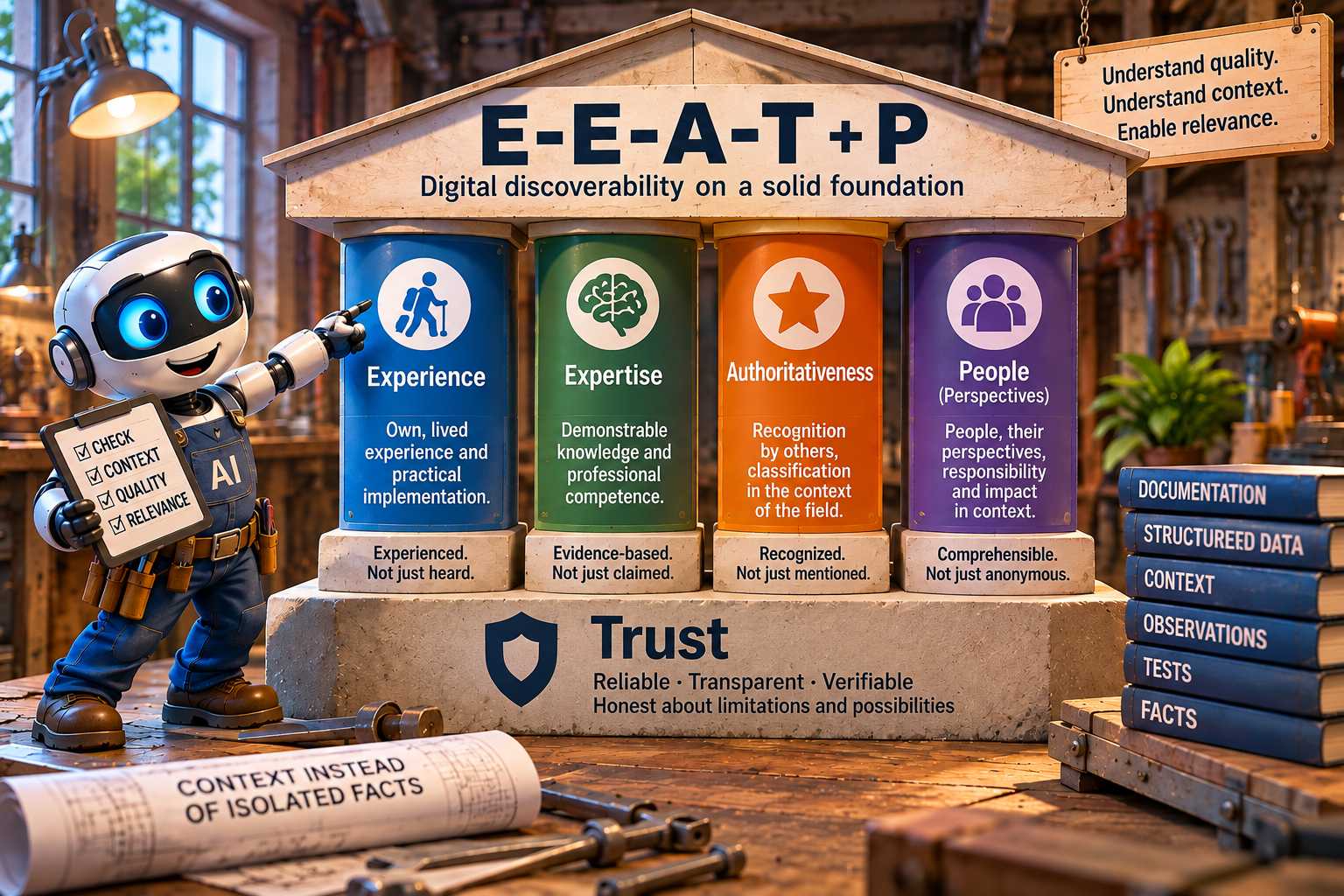
In our work, one thing in particular came to the forefront: the real-world experience of people who know what they’re talking about. Especially in technology-oriented companies, a large part of that valuable knowledge isn’t found in marketing materials, but in the experiences of employees, in products, processes, and customer projects.
Interestingly, Google itself added another “E” for “Experience” to its model in December 2022. E-A-T became E-E-A-T. Google explained that, for certain types of information, a person’s firsthand experience can be particularly valuable. At the same time, Google clarified that this did not introduce a completely new concept, but rather that this aspect should be more clearly reflected in the guidelines. [ Excerpt from the Google Developers Blog on E-E-A-T ]
At DBRS, we took this line of thinking a step further. We were also interested in the “P”: Purpose and Policies. Why does a piece of information, a service, or a company exist in this context? What is intended to be understood, and why is this knowledge relevant? And what rules, principles, and procedures are used to pursue this purpose?
This led us, at times, to develop our own working formula: E-E-A-T + P. The “P” was not an extension of the Google model, but rather our own addition during the development of DBRS and Context Publishing: “Purpose” describes the “why,” while “Policies” describe the “how” of responsible action.
From today’s perspective, it is noteworthy that Google now recommends examining content from the perspective of “Who, How, and Why.” Google describes the “Why” as potentially the most important question and also asks about a website’s primary purpose or focus. This is not the same as our “Purpose + Policies.” However, this development reveals an interesting similarity between the questions. [ Google"Create helpful, trustworthy, user-focused content" ].
This resolved the question for us
“How does content become visible?”
increasingly:
“How can people, search engines, and AI determine who is speaking, based on what experience and expertise, in what context—and for what purpose?”
Here, the discussion of E-E-A-T intersected with John Searle’s line of thought:
Meaning requires context - and context requires a recognizable origin, experience, and purpose.
As a result, our goal shifted increasingly from mere digital visibility to digital recognizability.
From a Minimalist Index to a Subject Index
The core of the https://tolksdorf.digitaldomain is represented in a register of meanings that is publicly accessible to people, web crawlers, search engines, and AI:
https://tolksdorf.digital/markdown/dbrs/production/dbrs_frontmatter_index.html
Today’s dbrs_frontmatter_index was not originally intended to be a comprehensive index of meanings. An early hypothesis was simpler: A central, streamlined index could serve as a starting point for search engines and AI systems and then direct them to the actual content.
SAMY, too, initially used the same index directly as a context source. At times, there was also speculation that a file like llms.txt could be used by interactive AI systems in a manner similar to an external system prompt. Further exploration of search, retrieval, and LLMs revealed that this model was too simplistic.
In the case of a specific query, the search index, retrieval, resolver, and selection mechanisms may lie between published information and the LLM. Therefore, the first step is to determine which information is relevant to the query. Only the selected context is then processed by the AI.
This changed the role of the index. A minimalist guide that merely indicates where something is located leaves a large part of the reconstruction of meaning up to the respective system once again. The index therefore became richer in content.
Today, the index does more than just indicate where information is located. It also helps describe what it means, what topic it belongs to, and the context in which it appears.
An interesting outside observation
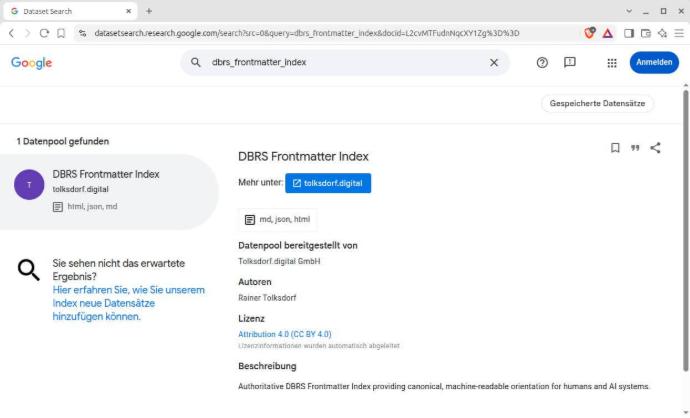
Google considers dbrs_frontmatter_index to be a dataset
Google Dataset Search demonstrated that this index can be recognized as an independent source of information even outside of DBRS. Google did not index just any CMS page from Tolksdorf.digital as a data source, but specifically the publicly available dbrs_frontmatter_index -that is, the linked index consisting of a descriptive table of contents, a keyword index, unique DBRS IDs, and references to the corresponding information objects.
This is not proof that Google understands the relationships described therein in the same way as DBRS, or that this structure causes specific search results. However, it is an observation that can be made from the outside: An external system has captured precisely this additionally published register of meanings as an independent data source.
A data source is an interesting observation - but not yet an insight
The fact that Google indexes the `dbrs_frontmatter_index` in Google Dataset Search as a data source was a notable external finding for us. It showed that the additionally published thesaurus can not only be found as an ordinary web page, but is also recognized as a standalone structured information source.
For DBRS, however, this observation was not enough. DBRS should not be optimized for Google. The goal is to publish content in a way that is search engine- and AI-agnostic, so that different systems can find, categorize, and process it as effectively as possible.
If DBRS is to remain agnostic, Google must not become the benchmark for the system.
For this reason, the research was expanded to include other search engines and AI systems -including Brave, Bing, and Microsoft services. The differences, in particular, proved interesting: the same published information is not necessarily found, categorized, or processed in the same way by different systems.
From Individual Observations to Contextual Insights
This raised a new question: What does a single observation actually tell us? A Google search result, user behavior on Bing, a response from an AI system, or an SEO score can each be interesting on their own. However, taken individually, they do not yet explain a company’s digital visibility.
This experience gave rise to the approach that is now known as Context Insights: Observations are not evaluated in isolation, but rather contextualized, compared with one another, and -where appropriate- supplemented by cross-checks, additional sources, and technical analyses.
The image is intentionally simple: a single measurement or test is an atom. Only when multiple observations are related to one another and understood within their respective contexts does a more robust picture emerge - the molecule, so to speak.
More Information About Context Insights
What the Different Systems Taught DBRS
Above all, the studies confirmed that different systems can use different approaches. A cryptic DBRS-ID can serve as a very unique identifier, while linguistically understandable titles, descriptions, topics, and keywords open up a different approach.
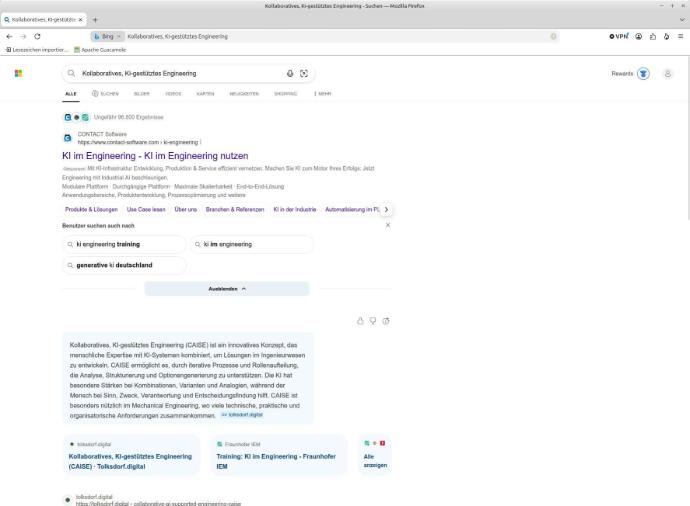
Some of these approaches were verified in practical tests. Titles, meta descriptions, and H1 and H2 headings proved to be particularly useful linguistic reference points. Bing, for example, was able to reconstruct key aspects of the CAISE concept described on a properly structured page and identify Tolksdorf.digital as the source. Structured information via JSON-LD was also confirmed as a machine-readable entry point.
Other hypotheses, however, remained unresolved. We were unable to either confirm or refute the usefulness of an additional colophon.
The practical implication was surprisingly simple: First, make clear and meaningful use of a website’s existing structures before creating any additional ones.
For DBRS, this did not lead to a focus on a single system, but rather to the opposite conclusion: unambiguous identity and linguistic comprehensibility should complement one another. The register of meanings was therefore structured not only to be technically unambiguous, but also, increasingly, to be expressive.
DBRS publishes information in a way that is as clear and accessible as possible. How a search engine or AI system processes this information is up to the system in question.
This also changed the nature of the investigation. The focus was no longer solely on the question, “Did System X respond correctly?” but rather on several distinct questions:
- Has the information been published and is it technically accessible?
- Is it detected and found by external systems?
- Is it assigned to the correct company, topic, or information object?
- Is their relationship reconstructed in a way that makes sense?
- If the right question is asked, will the company be identified as a relevant candidate?
Being found, being correctly categorized, being understood, and being recognized as relevant are therefore not synonyms. They represent different levels of observation.
Structure alone does not create meaning
DBRS can uniquely identify, structure, and link information, and make it available in a machine-readable format. But even the best technical structure is of little use if the substantive content is lacking.
Software cannot generate experience, expertise, or business realities that no one has described before.
This gave rise to two distinct but related tasks:
We need high-quality specialized information - and we need effective systems to support that information.
Today, these two sites are known as Context Publishing and DBRS.
- Context Publishing makes knowledge, experience, background, purpose, and connections explicit.
- DBRS helps to uniquely identify this information, link it together, and make it available in a format that can be reconstructed by different systems.
Context World combines both: the meaning the company is responsible for and its technical representation.
In summary, all of this led to the conclusion that relevance is a key criterion.
Relevance = Context AND Intelligent Processing AND structurered Accessibility
This qualitative relevance formula is a model for the practical significance of information. It relates to a background (context) and serves the purpose of intelligent processing (by whatever means and by whomever)—which is only possible if the information is visible and usable in a way that makes it citable and authoritative. SEO visibility, for example, is one aspect of “structured accessibility,” but it is never the sole key criterion.
One could put it this way: DBRS provides structured accessibility that enhances the relevance of Context World.
From a Personal Experiment to a Real Business
Up to this point, the development process had been heavily influenced by our own questions, tests, and cross-checks. The next step emerged from our collaboration with AMMANN Components.
We presented our thoughts to date on digital recognizability to Paul Ammann and Markus Halder. Paul Ammann’s curiosity, in particular, led to a very practical question: What does all of this mean specifically for AMMANN Components—and how exactly can we know?
This changed the focus of the study. The focus was no longer on DBRS itself, but on a real industrial company with its own history, manufacturing expertise, practical knowledge, customer relationships, and a digital presence that only partially reflected the reality of the company.
The reality of a business can be richer than its digital representation.
Context Insights at AMMANN Components
The studies, which had previously been conducted on a rather ad hoc basis, were consolidated in a broader and more systematic manner for AMMANN Components. Rather than using a single SEO metric or the perspective of a single search engine as the benchmark, different perspectives were integrated: published corporate context, search engines, AI systems, technical data collection, competitive analysis, and the knowledge of the company’s employees.

Thus, the question of visibility increasingly evolved into an examination of digital discoverability: What actually exists? What is published? What is indexed externally? What is found? What is understood? And under what specific requirements is AMMANN Components recognized as a suitable provider?
It became clear that general statements such as “innovative and customer-oriented solutions” or “the highest precision in Swiss quality” provide little technical specificity. This was evident in both search engines and AI systems. When analyzing a real company website, the implications became particularly clear: At times, an AI system was unable to reliably determine whether the site belonged to a manufacturing company or a specialized publisher of technical data sheets.
This made it clear: Effective corporate communication doesn't just have to sound positive. It must make it as clear as possible who is doing what, what is being done, and in what professional context this is taking place.
The study, its findings, and the measures derived from them for AMMANN Components will be documented in a separate reference report.
Mehr erfahren über den AMMANN Components Referenzbericht
What this means for Context Publishing
This development began with SEO and the question of how to make content easier to find. It led, through structured data, meaning, and context, to a different perspective: A company can do more than just publish individual web pages. It can also publish the context in which its information is intended to be understood.
Context publishing, therefore, does not mean controlling search engines or AI systems. It means designing the controllable aspects more carefully: information, identity, origin, context, relationships, and structured accessibility.
A website publishes content. A Context World also publishes the context in which that content is meant to be understood.
In this way, the company itself becomes the author of its digitally published context. This role as context author does not replace search engines or AI. However, it provides them with a better, responsible source of information from which they can derive their own processing.
Conclusion
We started by asking how content can be found more easily. That led to the question of how a company can be properly understood in the digital realm.

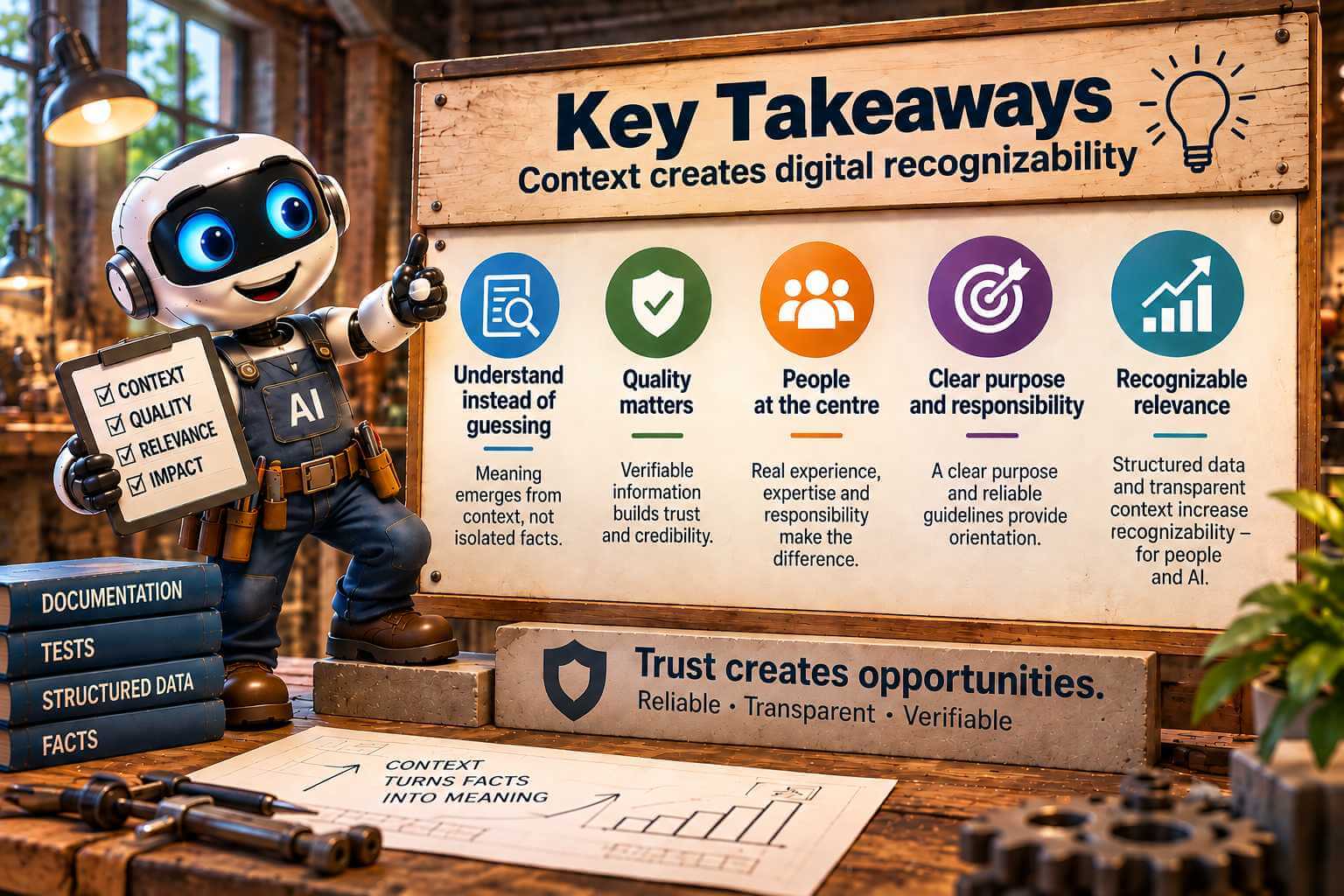
The development progressed from SEO through structured data and context to a semantic index. Observations in Google Dataset Search and other search and AI systems turned these into testable hypotheses. The differences between the systems led to an agnostic approach and ultimately to Context Insights: Individual observations are not overemphasized, but rather compared, contextualized, and supplemented with additional perspectives.
With AMMANN Components, this evolved into an examination of real-world business realities. The key is not to produce as many optimized pages as possible. What matters is whether skills, experiences, and contexts are published in such a way that people and digital systems can find them, contextualize them, and understand them as accurately as possible.
So that people can find what matters - and what is meant is understood.
Sources and Working Materials
- Google Search Central: Dokumentation zu strukturierten Daten und Dataset-Markup.
- Google Dataset Search: Eintrag des DBRS Frontmatter Index.
- DBRS Frontmatter Index: öffentlich publiziertes Bedeutungsregister von Tolksdorf.digital.
- Context Insights: Tolksdorf.digital – Methodik zur Einordnung und Verbindung unterschiedlicher Beobachtungen.
- DBRS / Context World – Arbeitsprotokolle und dokumentierte Suchsystem-Tests.
- AMMANN Components – Referenzbericht zur systematischen Untersuchung und den daraus abgeleiteten Maßnahmen (in Vorbereitung).