Trusted Context World Publishing - So that what matters is found - and what is meant is understood.
Agentic AI needs the right words. Trusted Context World Publishing conveys curated corporate reality in a transparent, rule-based, quality-assured, and verifiable manner between IT systems, people, and AI.
Investments in AI alone do not guarantee results.
Trusted Context World makes the meanings, structures, and relationships within your business world accessible to AI. This enables AI to be reliably integrated into work and processes. Business information is made understandable, statements verifiable, and interoperable according to defined rules for:
- traditional internal workflows and new AI-supported processes,
- external AI-supported information-, value creation-, and decision-making processes.
Orientation and Context Certificate
In Preparation.
How resilient is your company's digital information?
Does your company's digitally available information already serve as a reliable basis for work and decision-making?
- Do employees come up with the same answers?
- Are the sources verifiable?
- Is the information up to date?
- Are responsibilities clearly defined?
- Can AI reliably derive the same conclusions?
- How do you ensure consistency across the website, SharePoint, and documents?
- Does your company's online presence accurately reflect the reality of your business?
- Is your company being understood correctly by ChatGPT, Claude, and other AI systems?
If you answer “No” to one or more of these questions, it's worth building your Context World.
How can you ensure that company data remains relevant both internally and externally and is used properly?
Trusted Context World Publishing refers to the combination of procedures, working methods, and the tools used for this purpose
Company information from documents, the intranet, the Internet, and other sources is continuously maintained and expanded - for example, in the CMS, Microsoft 365, or SharePoint. In Trusted Context World Publishing, this information is structured into a reliable corporate context. Using the Context World Development System (CWDS), a license-free, machine-readable CWDS index can be generated and integrated for various target systems in accordance with policies. Implementation and maintenance can be provided as a service by Tolksdorf.digital or handled entirely in-house by the company.
AI and large language models (LLMs), as well as their application methods, are constantly evolving, but Context remains crucially important as a foundation
The evolution of chatbots into Agentic AI shifts the focus from crafting individual prompts to a reliable business context, clear objectives, and organized collaboration between humans and AI. The following overview highlights the most important changes.
Weshalb Trusted Context World Publishing entwickelt wurde

Anyone who has ever dealt with CRM, file storage, or master data is familiar with this fundamental problem when using IT systems. People use different versions of a file, often use different words to refer to the same thing, or the same word can have different meanings depending on the context.
Learn more about why Trusted Context World was developed.
AI can only work with what it understands. Trusted Context World Publishing creates the context so that information can not only be found, but also properly contextualized, understood, and used responsibly.
Out of respect for people and AI, the focus is on comprehensibility, citability, and shared meaning.
That is exactly what Trusted Context World Publishing stands for. [Rainer Tolksdorf].
Remarks on AI in Everyday Business Life and What Trusted Context World Could Achieve
A Trusted Context World emerges from the digitally accessible corporate world. This may include, for example:
- the company's website,
- Intranet and SharePoint,
- Documents and manuals,
- Data extracts from BI, ERP, CRM, and other line-of-business systems,
- Product and service documentation,
- Quality Management,
- Processes and work instructions,
- Terms, Responsibilities, and Rules,
- Employees' experience and expertise,
- Public information about the company.
A Context World grows gradually. Many companies start with their website and selected documents, and later expand it to include additional information sources. Each company decides for itself which information sources to include and how to use them.
Almost every IT project begins with the solution before the challenges posed by the context have been fully understood. In ERP or CRM projects, this is particularly problematic - wrong decisions are costly and difficult to correct.
Early AI initiatives often take a different approach: Limited experimentation with existing tools enables learning without having to define everything in advance. This hands-on approach becomes a learning experience - provided that the lessons learned are evaluated and placed within a viable context. Lasting impact is achieved as soon as people interact with AI and context.
Customers, partners, suppliers, and others also use AI to search for information, compare companies, and prepare for decisions.
AI systems use whatever they can find and understand. If statements are unclear or contexts are missing, the resulting picture will be incomplete or inaccurate. Companies cannot fully control what AI claims about them. However, they can make their business world recognizable, understandable, and reliably accessible.
Context World creates the right context for this - for people, the Internet, and AI.
AI Can Do More Than Just Text and Efficiency
Many AI initiatives start with text generators, assistants, and automation. While this makes sense, it doesn’t go far enough. AI becomes truly valuable when it recognizes connections, makes knowledge actionable, supports decision-making, and enables new forms of collaboration and value creation.
To do that, it needs more than just data and tools: it needs context that is understandable, reliable, and interoperable.
Recognizability is a prerequisite for AI to provide coherent responses—this applies to both internal systems (e.g., SharePoint) and external ones, such as websites or e-commerce platforms. Content relevant to AI combines an understanding of the meaning of a statement with its visibility. That is exactly what you achieve with your Context World.
With AI, specialists and managers can independently access information, test assumptions, develop alternative solutions, and test initial results. This reduces their dependence on predetermined information channels and specialized tools. Reliable context ensures that this new autonomy leads not to arbitrary results, but to results that can be built upon.
For innovative professionals and leaders, AI is already changing the way ideas are generated, knowledge is acquired, solutions are developed, and decisions are prepared. Work and communication processes are becoming more exploratory, iterative, and driven by personal initiative.
Context World is aligned with this trend. It helps companies remain effective and connected in these new, AI-driven exploration and application processes by providing a reliable context.
The Trusted Context World Project and Its Use
The company's contribution
A Trusted Context World is not created by a one-time AI project. It grows out of a company’s existing knowledge, systems, experiences, rules, and relationships, as well as the ongoing maintenance (curation) of the corporate context.
Establishing a Trusted Context World involves
- a contribution toward context publishing (describing your company's world, data maintenance, project management),
- optional context engineering by Tolksdorf.digital to integrate the resulting, royalty-free CWDS Index into your target systems. This collaboration takes the form of a service provided within the framework of open innovation.
This is what the two Trusted Context World models described below represent
- BASIC with basic functionality and self-directed integration with guidance - are available as well as
- ENTERPRISE Model.
Context Publishing Managed by Customers Themselves
First, we clarify what is to be understood and through which channels -and according to which rules- it should be made available. This includes business objectives, relevant information sources, terms, meanings, relationships, rules, and responsibilities. Existing content is not merely collected but categorized from the perspective of the respective business unit. This creates a robust model of the business world before technical processing and AI interpretation begin.
More information about Context Publishing
Tolksdorf.digital provides support through methodologies, the necessary tools, and a transparent pipeline. Depending on whether the architecture is BASIC or ENTERPRISE, the tools are either deployed as a service or integrated into the company’s IT infrastructure. Responsibility for content remains with the people and roles who understand the company and its context.
Website and Intranet Maintenance (Curation)
The website, intranet, and other systems remain important sources of work and information for Context World. As part of Context Publishing, this content will continue to be professionally maintained and kept up to date. These responsibilities and tasks can also be handled to a “certain extent” without tools such as the Context World Development System (CWDS) mentioned below. However, the many initial challenges faced by AI projects suggest that this is often precisely where action is needed.
DBRS supplements these systems with a structured “Context World” layer. Changes can be reprocessed, verified, and linked to existing contexts. This ensures that the visible content and the machine-readable context remain as consistent as possible.
Coordination
The corporate context affects many areas simultaneously: line departments, IT, quality management, data protection, communications, marketing, and corporate management.
Clear lines of responsibility and coordinated approvals prevent conflicting statements and uncontrolled parallel processes. Context World integrates these responsibilities without consolidating them into a single central office. The 7C CI/CD approach is described further down on this page.
A step-by-step approach is possible
Existing data sources can be gradually incorporated into the Trusted Context World. For websites on Internet domains, it is more efficient and advisable to incorporate them in their entirety to avoid confusion for search engines.
- DBRS from Tolksdorf.digital (see below) helps to gradually capture, structure, and verify this context and make it usable for various applications.
- Your company retains responsibility and full control over its own business operations.
Von Intranet und Content Management Systemen (CMS) über Context Analytics zum Trusted Context World Publishing
Existing CMSs and intranets, such as SharePoint, can be expanded into a Trusted Context World by integrating a CWDS Index.
Using Context Insights tools and external observation sources such as
- Context Insights (Python Tool Set from Tolksdorf.digital)
- schema.org
- Google Search Console
- BING Webmaster Tools
- Seobility
A realistic assessment is conducted of how AI and search engines "perceive" data. Content is adjusted as needed using context publishing and context engineering.
From AI Agents to Trusted AI Agents
Existing CMSs and intranets, such as SharePoint, can be expanded into a Trusted Context World by integrating a CWDS Index. Instead of merely deriving information from available data, they work with agreed-upon meanings, sources, rules, and responsibilities. This makes their results easier to understand, more traceable, more citable, and more reliably usable.
The Trusted Context World does not guarantee error-free agents. However, it creates a controlled and verifiable foundation on which AI agents can operate more responsibly. With better context, AI agents that have not yet met expectations can benefit from adjustments.
Trusted Context World Publishing BASIC and ENTERPRISE
Trusted Context World Publishing can start with an existing website and be gradually expanded into an integrated enterprise architecture spanning multiple systems and presentation layers.
Trusted Context World Publishing - BASIC
BASIC allows you to get started with an existing website or content management system.
- Context Publishing is handled in-house by the company.
- Tolksdorf.digital provides the CWDS Index and summary blocks or colophons for search engines and AI.
- The results are integrated, for example, into an existing WordPress or Odoo website.
- Content, reviews, and approvals are primarily managed manually.
- BASIC is particularly well-suited for small and medium-sized businesses, individual websites, and clearly defined areas of application.
Trusted Context World Publishing - ENTERPRISE
ENTERPRISE is expanding Trusted Context World Publishing into an integrated publishing architecture for multiple systems, websites, and AI applications.
- Existing components of BASIC can be adopted.
- The Context World Development System (CWDS) and an integration layer will be integrated into the company's IT infrastructure.
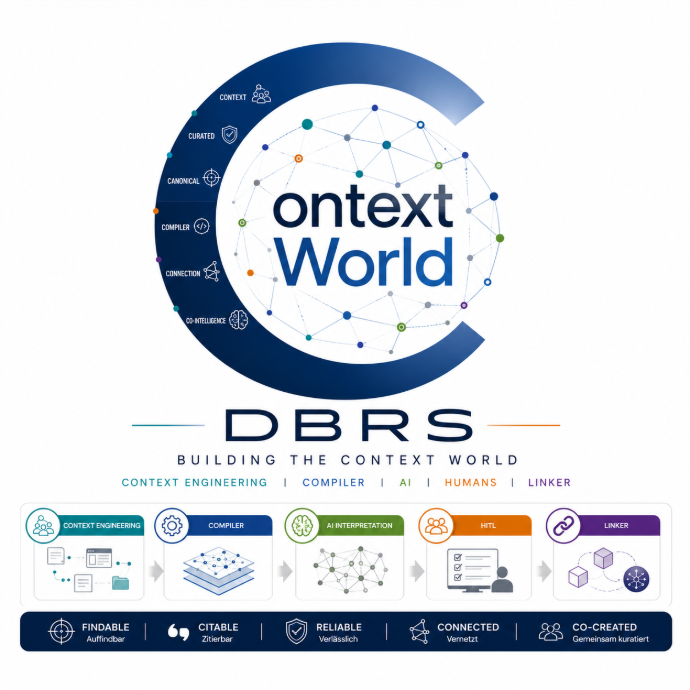
- The compiler and linker (part of the Context World Development System) generate and link the machine-readable enterprise context to the CWDS Index.
- Presentation and access layers are provided for websites, SharePoint, intranets, AI systems, and other applications.
- Context Engineering and Digital Engineering support integration, automation, and further development across multiple target systems.
The transition from BASIC to ENTERPRISE can be done in stages. The decisive factor is not the size of the company alone, but rather how many information sources, target systems, areas of responsibility, and approval processes are to be integrated.
Where can Trusted Context World be experienced?
The website https://tolksdorf.digital is itself a public, experimental Trusted Context World. It is based on a self-hosted Odoo 16 Community Edition website, with many technological and thematic enhancements. The content is continuously expanded to include topics related to digital innovation.
Examples:
- AI Innovation Mentor Samy - feel free to try it out without signing up:https://tolksdorf.digital/samy
- How search engines “see” the domain tolksdorf.digital:https://tolksdorf.digital/markdown/dbrs/production/dbrs_frontmatter_index.html
- Trusted Intelligence Charta: https://tolksdorf.digital/dbrs-trusted-intelligence-charta
- Technical Implementation in the Workplace:https://tolksdorf.digital/dbrs-llm-knowledge-hub
- Google Search Index Interface from Tolksdorf.digital: https://tolksdorf.digital/dbrs-google-search-index-interface
- LLM & KI-Entry | DBRS | llms.txt | Tolksdorf.digital: https://tolksdorf.digital/llms
Case Study: Ammann Components, Tägerwilen (Schweiz)
- Implementation is currently in the rollout phase:https://www.ammann-components.com/ki/
Access available upon request. The application is currently being rolled out (July/August 2026). - Contact: Mr. Halder, https://www.ammann-components.com/kontakt/
Tolksdorf.digital's Contribution to Your Trusted Context World
Context Engineering, CWDS Index
Building on the groundwork laid by Context Publishing, Context Engineering makes approved context available where it is needed: on websites, in intranets, for AI applications, or in information, value-creation, and decision-making processes. This process takes into account which information is intended for public use, internal use, or only for specific purposes and recipients. Thus, rather than simply publishing as much as possible, appropriate context is made available in a controlled manner. The Context World Development System (CWDS) is used to create the CWDS Index and deploy it on customer systems.
The Context World Development System (CWDS)
The Context World Development System helps companies build, maintain, and further develop their Context World.
CWDS can also be set up on customer systems and configured for automatic delivery from the CWDS Index. In that case, the system runs in "Pending HITL mode" until the responsible parties approve the status.
Context Insights
Goal: Company information should keep pace with the real business world.
Companies are constantly changing. Is this also reflected in the context - the digital representation of the company’s reality? New capabilities emerge, customers interpret terms differently, or AI systems classify a company in unexpected ways.
Context Insights reveals how context is understood, what is changing, where gaps exist, and where misunderstandings arise.
Adaptation and Development of Context and 7C-CI/CD as a Process Model
Just as a company or organization evolves, so does its business environment (context). Capturing this requires context publishing, context engineering, and comprehensive coordination with the company’s approach. To this end, Tolksdorf.digital recommends the 7C-CI/CD process model for project work, which is a structured and agile framework for continuous innovation and implementation.
What 7C Stands For
- Compose - Ideas, Plans, Motives, Starting Point
- Connect - Ideas, interested parties, and key figures
- Coaching - Teach and Share the necessary knowledge, supported by AI
- Co-Create - Draft and coordinate texts and content
- Complete - Implementing Drafts of Texts and Content
- Change - Introduce the content
The Seventh C - Chat Innovation
- Exchange on an equal footing is of central importance during all phases - supported by AI.
More about the 7C/CI/CD process model
DBRS as the Core Technology of the Trusted Context World
If Trusted Context World Publishing is viewed as a more comprehensible goal or project vision in terms of content, the Digital Business Relevance Suite (DBRS) represents the technological and scientific foundation that serves as the path to that goal. The DBRS describes the entire background.