
Products and services are increasingly being discovered through AI platforms such as Perplexity and ChatGPT; traditional search remains important. This article explains why AI discoverability is worthwhile, what steps you can take to achieve it, and why “AI visibility” is an unfortunate but commonly used term.
Customer Benefit
- More qualified inquiries: The right pages appear in AI answers.
- Control & compliance: Steer visibility while preserving data privacy.
- Measurable: Citation rate, time-to-citation, qualified leads.
Starting Point
- AI platforms deliver answers instead of link lists.
- Many SMEs are structurally not AI-discoverable.
- Goal: Prioritize what should be public; hide what must remain internal.
Note on the commonly used terms “AI visibility” and “SEO visibility”
Artificial intelligence responds to language, as the name “Large Language Model” (LLM) suggests. These are technically entirely different systems from, for example, web crawlers. That is why we refer to “AI detectability” here. Incidentally, the term “SEO visibility” also requires clarification; it simply means that publishers make content visible—which does not imply any guarantee of visibility to searchers. Translated with DeepL.com (free version)
Results
In a client project for AMMANN Components, results were systematically derived. Based on SEO search tests, a practical approach to digital visibility and context publishing was developed for AMMANN Components. The results are continuously incorporated into the website, trade show appearances, and the AI mentor Edison.
The goal is not to promise rankings or AI mentions, but to make companies and their capabilities clearly recognizable to both people and AI, to evaluate them, and to continuously improve them. The Tolksdorf.digital website has already demonstrated this.
More about the AMMANN Components Project
Solution Concept - from SEO to GEO
- AI sitemap + Frontmatter v1.3 for machine readability.
- JSON-LD/OG consistent with canonicals & freshness signals.
- robots.txt by design: allow what should be visible; block internal content.
- Monitoring via Matomo + Server-Logs.
Methods and Tools
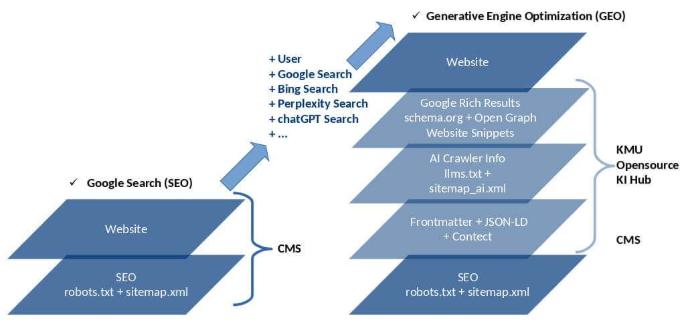
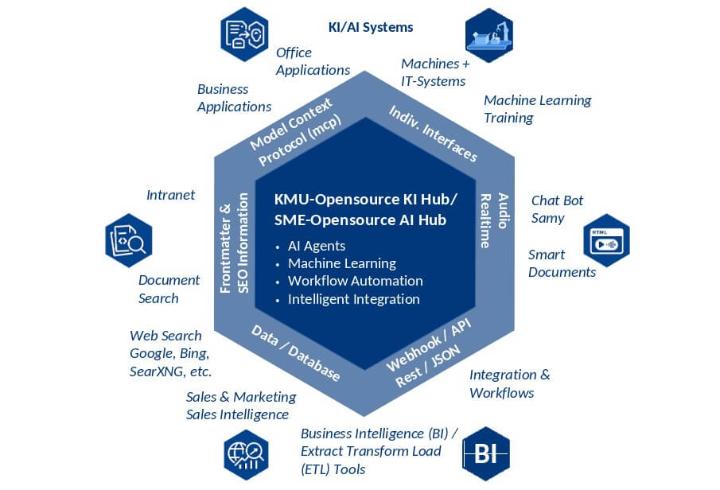
- Tools: n8n (Workflow), Frontmatter v1.3, JSON-LD/OpenGraph, robots.txt, sitemap_ai.xml, Matomo/Plausible, Caddy.
- Planning + Realisation: Experience Innovation.
- Basis: KMU Opensource KI Hub
Project Contribution and Role
- Tolksdorf.digital: Analysis, concept, setup (AI sitemap/frontmatter/robots), CMS implementation, monitoring & evidence, training.
Reference Customer
- Ammann Components, Tägerwilen
Reference Contact
- On request
Frequently asked Questions (FAQ)
Why should an AI find a company’s website?
- So your offerings appear in answers, not just search results—boosting relevance and conversion.
May an AI platform use my data at all?
- Yes, for public content and within robots/terms. You control this via robots.txt, noindex, and license notices.
Are my data truly safe when an AI reads them?
- Public pages are meant for that. Sensitive content: don’t publish it; protect access; block crawlers.
Will Google and Bing become irrelevant?
- No. They remain core infrastructure; many AI systems build on them. You need both: classic SEO and AI visibility.
What is Answer Engine Optimization (AEO)?
- Optimizing to show up in direct AI answers (structured content, Q&A, clear signals).
What is Generative Engine Optimization (GEO)?
- Optimizing for generative systems (long-form answers). Focus: context, structure, freshness, source clarity.
What is Search Engine Optimization (SEO)?
- Tech + content + authority so pages are found in traditional search.
Why is SEO important for SMEs?
- SEO provides the baseline visibility. Without it, AI systems often lack reliable signals.
How can older websites be made accessible to AI platforms?
- Incrementally modernize: add an AI sitemap, backfill Frontmatter/JSON-LD, set canonicals, review robots, prioritize key pages.
If more and more people are searching with AI platforms, what does that mean for searching on the internet?
- Often ready-made answers get served instead of lists of links—this saves time, but requires critical review.
- AI summarizes sources and cites them (sometimes well, sometimes incompletely)
- Sources require
- Demand becomes part of the search
- Hybrid search with PI platforms and search engines
- Have reports generated by the AI platform for download
Sources and Further Reading
- How people use ChatGPT (NBER Working Paper): https://www.nber.org/system/files/working_papers/w34255/w34255.pdf
- SME Opensource AI Hub (Overview): https://tolksdorf.digital/kmu-opensource-ki-hub
- dbrs_frontmatter_index.html Implentation: https://tolksdorf.digital/markdown/dbrs/production/dbrs_frontmatter_index.html
- Tolksdorf.digital Specification Frontmatter v1.3: OpenGraph & Schema.org (v1.3): https://tolksdorf.digital/ai/spec/index.html